Content strategy one-pager
What actually does content strategy mean? And how do you document it? That has changed a lot over the last couple of years.
The easiest way to explain the way I do it, is to just show you an example :)
This is easiest to read on desktop.
Strategy elements
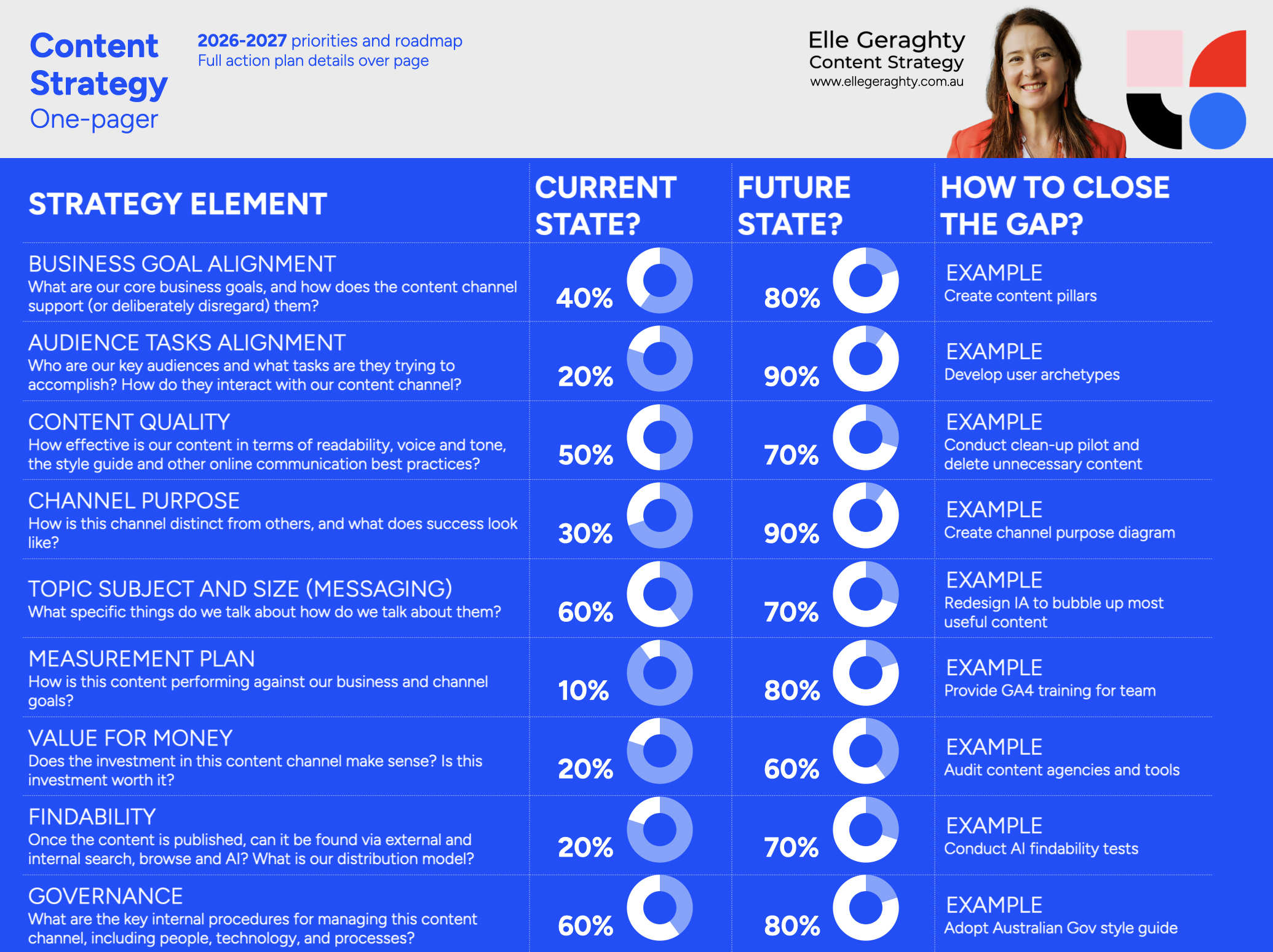
First, I list all the strategy elements I want to influence. This example includes classic elements in a web content strategy. This list alone is super useful. These are the elements you should be managing for your website.
Current state assessment
Then I give each of those elements a percentage ranking. I want to know on a scale of one to ten how well we are doing for each of those elements. For example, are we measuring well? Do we have a strong governance plan?
This involves lots of conversations and exploration of data to understand what is actually going on.
Future state assessment.
I want to know which one of these elements is most important, and hence which ones need to improve the most.
Your instinct is that each of these should be 100 per cent. Your job will be to manage that instinct and instead decide that, in the time frame allocated (in this case, 24 months), which elements need to improve the most.
Strategy is all about prioritising and acknowledging that all elements are not created equal. You must choose to influence the elements that will have the most impact on your overall goals.
Element order
In this example, I have ordered the elements the way I wanted to introduce them to you. It might be a better idea to order them by either the current state (low to high), the future state (low to high) or even the gap between the two (high to low). That way, the one-pager demonstrates not just the elements but the effort involved to boost them.
How to close the gap
This is where the real work of effecting change starts. Mapping the situation is a great first step, but putting into practice a series of actions to close the gaps is what this diagram is all about. Understanding, resourcing and completing a set of activities to bring about change.
How to make this
Keep it simple. To start, use either a spreadsheet or a table. I made this diagram using Keynote.
Next steps
For each of these elements, you want a slide that explains your assessment rationale. WHY have you allocated the current state and future state assessment? Site evidence to justify your assessment.
All this is really hard
This kind of framework can make it seem like this work is easy. It is not. Balancing the people, tech and processes in content strategy for digital spaces is super hard. We work in complex, messy spaces with lots of moving parts and agendas. This framework helps you find a place to start chipping away at it all.
Need help?
Get me on board to help you customise a plan for your organisation. Reach me via the contact page.