
ChatGPT and your content: what works and what doesn't
Oh my gosh - the hype about ChatGPT is massive. Let's look at five examples of ChatGPT in use and evaluate whether it is actually a good solution.
ChatGPT works well in some content contexts but very poorly in others.
The best way to think about it is as a very helpful but very junior assistant who needs a lot of supervision. I expect that assistant will be growing up quickly however :)
Examples of ChatGPT in use
These five examples help to assess the risks, limitations and potential of the tool.
1. Write social media snippets
It does a pretty good job at this - but leaves a lot of work undone
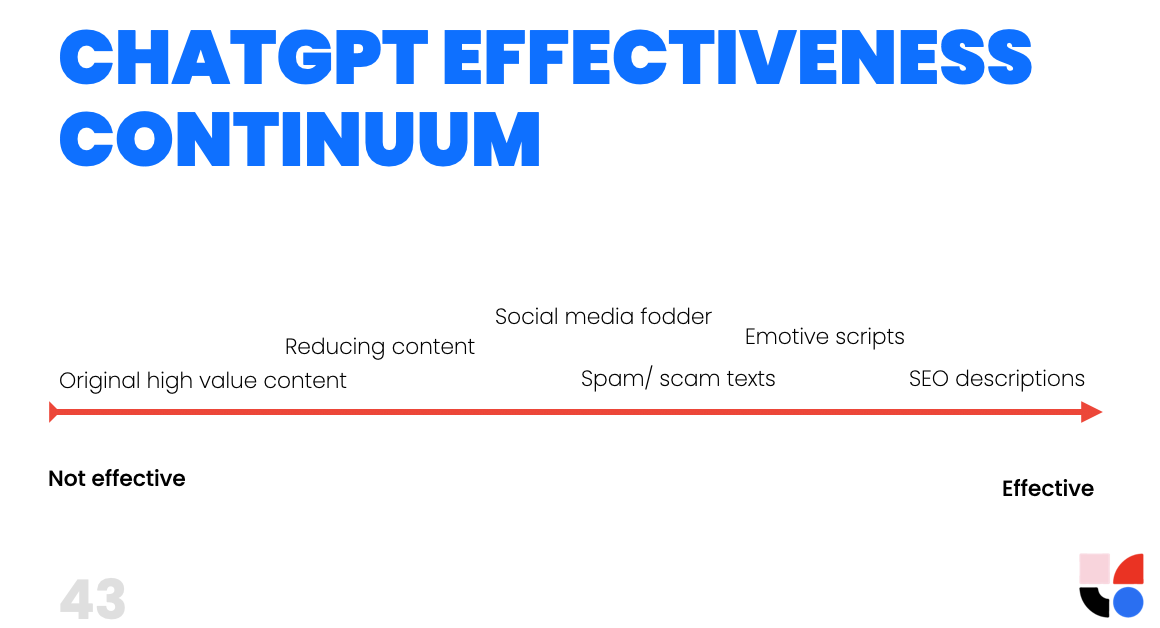
5/10 rating
2. Write a scam prompt
It also does a pretty good job at this - safety controls are pretty easy to get around.
6/10 rating
3. Write a radio script
It searched the internet (pre 2021) for information on a guest and used an enthusiastic and enticing tone.
7/10 rating
4. Reduce content
One of the biggest challenges a content strategist has is to streamline and curate content. ChatGPT is pretty bad at helping with this.
2/10 rating
5. Summarise content for example a SEO description
I really liked how ChatGTP did this. Word on the street is that Google penalises SEO copy it deems to be created by generative AI, but it think the payoff (if you are working with large content sets and limited resources) is worth the risk.
9/10 rating
Summary
GhatGPT is great for:
Low-value content creation
Repeatable content creation
Mass content creation
In conjunction with other tools (also con)
Ideation and brainstorming
Research
low literacy assistance
Chat GPT is not good for:
High-risk content
High-value content
Culturally sensitive content
Complex content
Expert content
Credible content
In conjunction with other tools (also pro)
Risks
ChatGPT comes with some well documented risks
Bias
Transparency
Workforce disruptions
Deepfakes
Security
Community blowback
Plagiarism
Customer information privacy
IP leakage